One of the techniques used to attract and capture customers in digital communication is the Inbound Marketing. In the area that concerns us, that of Investor Relations, helps investors to keep the company listed on their radar and manages to convert potential investors first into followers so that they can later become shareholders; it allows analysts to awaken the interest of analysts so that they also become followers, who will serve as prescribers to turn potential investors into shareholders. As we can see, it becomes ideal when we want to awaken and attract the interest of the investment community and attract visits to the Shareholders and Investors area of the company's website and then convert those visitors into part of our shareholding. We are going to explain what it is and how it can help any listed company attract investment, as it works for both B2B and B2C companies in any sector.
Inbound marketing basically consists of making it the potential customer, in this case the potential investor, who finds the company (through its website) instead of the company looking for it, thus reducing the cost per acquisition of each visitor. How is it achieved? Attracting him with useful, relevant content and adding value at each stage of your journey on the web and, in our specific case, through the Shareholders and Investors area. Unlike traditional (outbound) marketing, inbound does not need to strive to attract the attention of potential customers, since, by creating content designed to address the problems and needs of visitors, quality prospects are obtained and trust and credibility are generated for the company. It is not an immediate process, but it will gradually allow us to get to know our potential investor better, to better understand their needs, to give them valuable content, thus giving them a better perception of the company, and, therefore, finally turning them into a shareholder, but above all, into a prescriber.
The essence of inbound marketing lies in accompanying the customer throughout the purchase process.
The basic aspects that are handled in inbound marketing are:
Buyer people: Identifying the different types of clients or investors that we need to address and what their characteristics and needs are will make it easier for us to approach them later.
Contents: They must be appropriate and able to create maximum interest for our target audience. They must respond to the basic needs of potential investors and provide answers to their questions and concerns. A good Equity Story, versions of it adapted to different audiences (institutional investors, analysts, ISR, investment funds, retail shareholders, journalists, employees, etc.), earnings reports in different formats (pdf, navigable version, infographic, videos, etc.), specific microsites, monothematic landing pages (ESG, environment, COVID-19, etc.) are some of the options.
Segmentation and personalization: As potential investors get to know the company better and place it on their radar, and this to them thanks to marketing techniques that allow them to identify and segment the profile of the potential investor, they must be offered content that allows them to go deeper into the business and that covers their specific needs.
Analytics: It must be present throughout the inbound marketing process and funnel. It will allow us to know how to define our messages based on the traffic obtained, to see the type of content that works best for each type of audience and which ones have obtained the best results in order to adjust communication campaigns and obtain a better conversion.
The essence of inbound marketing lies in accompanying the customer throughout the purchase process, that is, contacting them at the beginning and guiding them through content adapted to their profile, through each of the stages of the purchase. In the case of Investor Relations, we must think about what journey we want the investor to take in the Shareholders and Investors area of the company's website will be like, how we can awaken their interest thanks to our Equity Story, what concerns, questions and doubts may arise and how we want to answer and solve them by facilitating the consultation of relevant, financial and non-financial information. In addition to offering you content that answers your questions, this journey should ensure that the maximum number of points of contact are generated between the visitor and the company, which will allow us to generate a relationship of trust between the two that should ideally end with the purchase and subsequent loyalty of the user, in our case, with the incorporation of the company into the investor's portfolio.
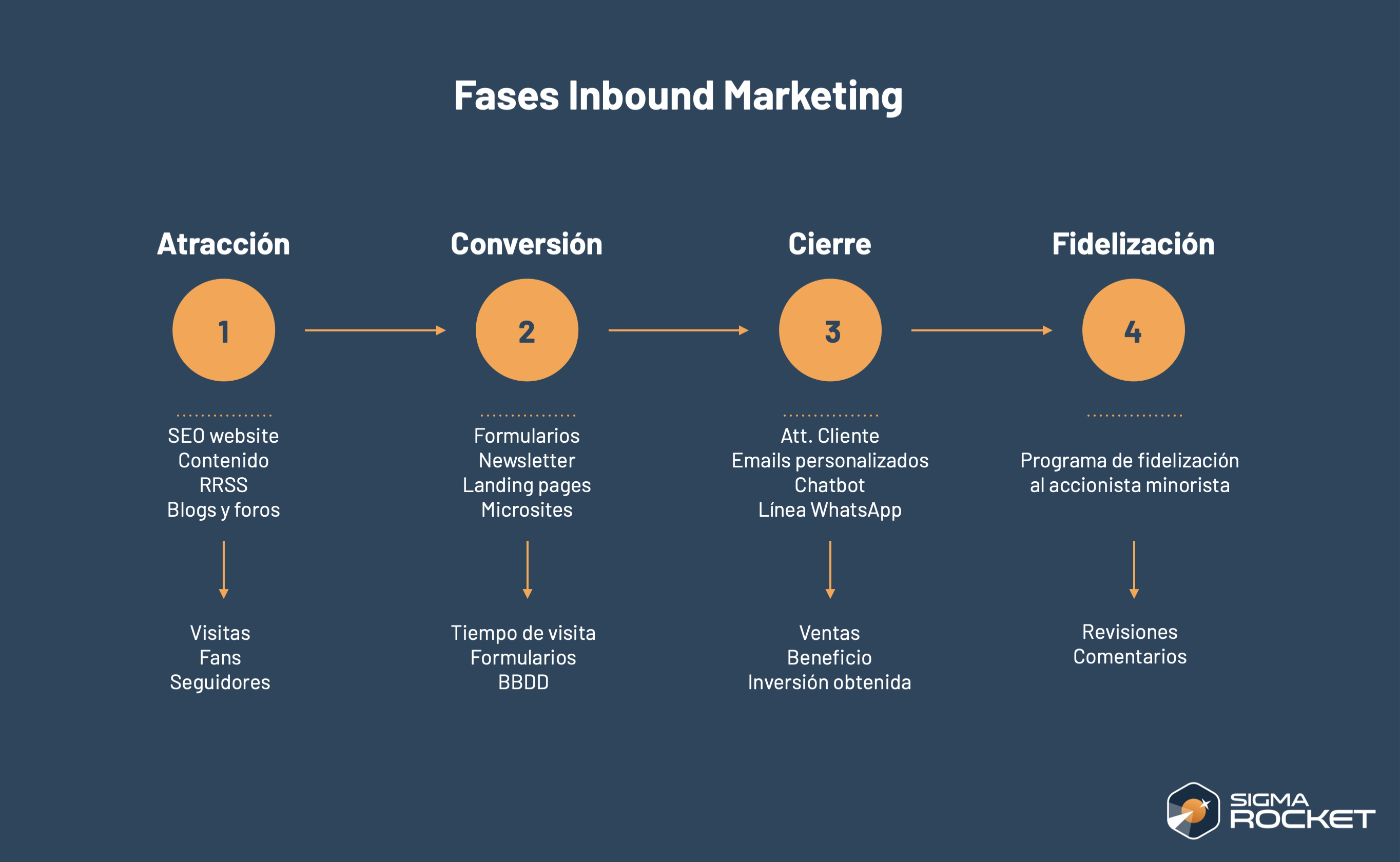
Below, we detail the stages of that conversion journey or funnel:
- ATTRACTION: It's about attracting potential customers to the Shareholders and Investors area of our website and becoming our guest. We will be able to do this through the tools available for this purpose in inbound marketing: good SEO optimization of the site and specifically of the Shareholders and Investors area, social media, generation of content that attracts the attention of our potential investor, forums, blogs, etc. The metrics that we will have to take into account at this stage will be the visits to the site, the fans and followers obtained on the company's social profiles, the links referring to the content, etc.
- CONVERSION: To continue increasing the relationship with the potential customer or, in our case, the potential investor, and to generate more trust in the company to transform them into a follower, we must offer them personalized content focused on their needs; in this phase we must begin to activate mechanisms that allow us to collect information about the visitor and feed our database. Here, lead scoring (assessment of a lead's qualification level) and lead nurturing (usually automated sending of personalized and valuable content to different types of users and depending on the time of purchase they are in) come into play, techniques that allow us to evaluate our lead and continue to accompany them through the conversion funnel. To find out how this stage is working for us, we will measure the time spent visiting the Shareholders and Investors area, the conversion rate of the completed forms, the quality of the data obtained, etc.
- CLOSURE: This is the penultimate stage, the one in which the last doubts and needs of the potential investor must be resolved and clarified before closing the sale. The objective is to transform the leads that have been obtained in the previous stages, into investors and shareholders of the company. Customer service is of great importance in order to successfully close the sale, so we will offer different options for contacting the company to answer the potential customer's last questions before making the purchase. In our case, a good shareholder office, the ease of answering and answering questions by phone or email, a chatbot service or a WhatsApp number will make it easier to complete the transformation from a follower to a shareholder of the company. The metrics that are taken into account at this stage are sales and profits obtained.
- LOYALTY: The last stage and perhaps the most important, since it is one of the bases of inbound marketing: building loyalty in order to obtain company prescribers who will help attract more investors and shareholders. At this stage, the company must focus on cross-selling and up-selling, but in our case, we have to focus on making our shareholders and followers ambassadors and promoters of the company, because a satisfied shareholder or analyst will speak well of the company and attract more capital. Retail shareholder loyalty programs are key at this stage, but we'll talk about this and go into more detail in another post.
We have seen that the inbound marketing methodology is based on strategies to identify what content is most attractive to offer to our audience on digital platforms and channels, but the real success of this technique lies in knowing how to make the most of the needs of site visitors, offering valuable content that leads potential investors to make the final investment decision in the company.
-
Daniel Campoy Silva
Founding partner of Sigma Rocket