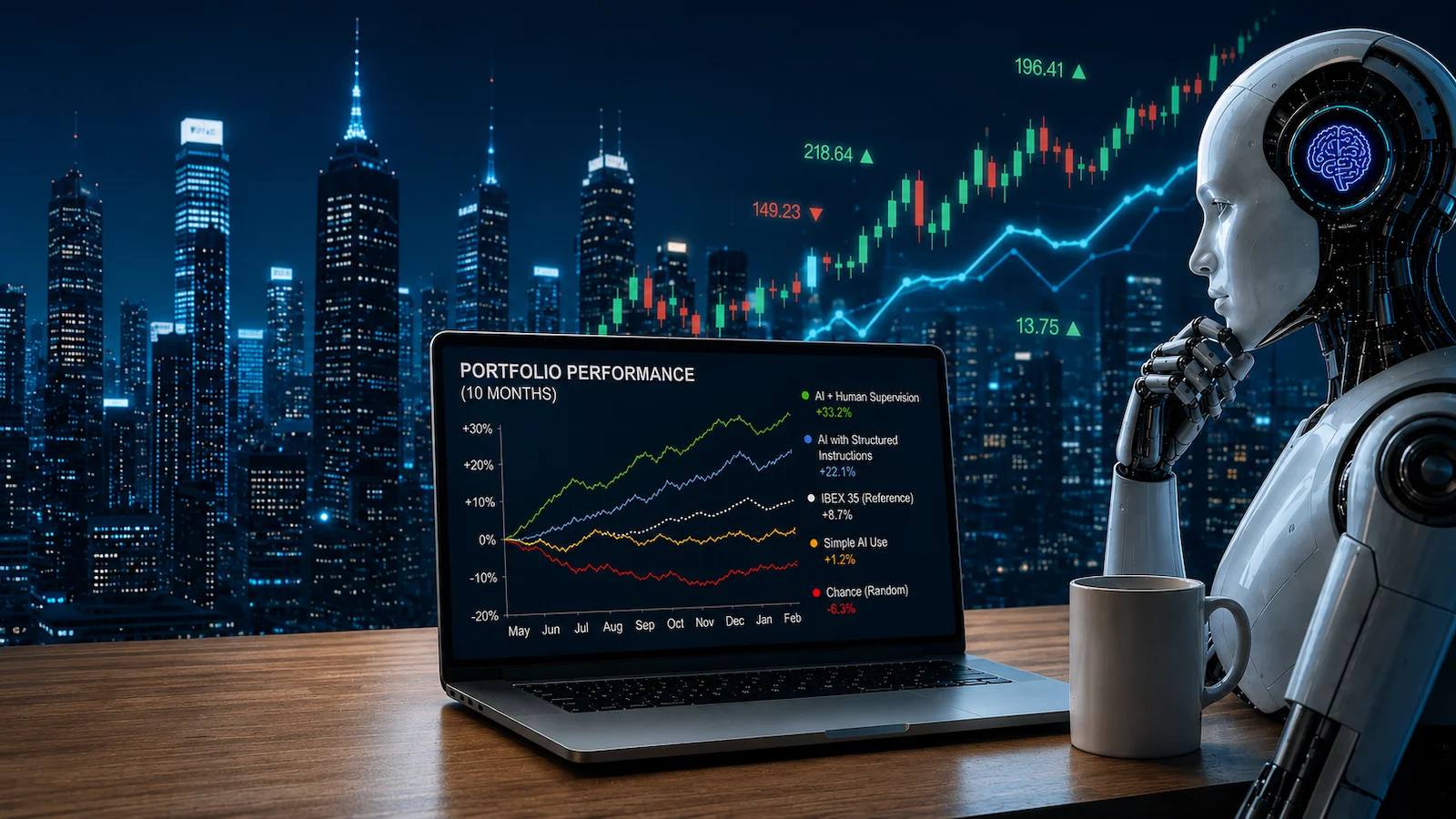
A recent study by the National Securities Market Commission (Large Language Models and Stock Investing: Is the Human Factor Required?) tries to answer this question by analyzing the performance of several advanced AI models in a real investment environment. For ten months, researchers evaluated whether tools such as ChatGPT, Gemini, DeepSeek or Perplexity were capable of generating recommendations on IBEX 35 actions that outperformed the market.
The results show a complex reality. On the one hand, models are able to construct coherent, well-structured and apparently sophisticated explanations. However, that capacity is precisely one of its biggest risks. The study identifies what it calls a “flow trap”, answers that sound convincing but may be based on miscalculations, misinterpretations, or even made-up data. This is especially problematic in an environment such as the financial one, where small failures can translate into wrong investment decisions.
In fact, when used in the most common way, that is, with simple questions and without context, models provide little value. The recommendations generated in this scenario offer results very similar to investing without judgment, with returns practically indistinguishable from chance. This suggests that the intuitive use of artificial intelligence, as an inexperienced retail investor would, is not only limited, but potentially dangerous.
However, the landscape changes significantly when more structured instructions are introduced. By guiding models with clear financial criteria, specific variables and defined analysis frameworks, their predictive capacity improves markedly. In these cases, the results begin to show higher returns than the market, which indicates that AI can provide value when used correctly.
The biggest leap in quality occurs when human oversight comes into play. When analysts review, correct and refine the responses generated by models (Chain-of-Thought), performance improves even more and becomes more consistent. This approach, based on collaboration between human and artificial intelligence, makes it possible to detect errors, validate assumptions and prevent errors in reasoning from translating into wrong decisions.
Another key aspect of the study is the importance of the quality of the information used. When models base their analysis on official sources, such as records obtained from the CNMV (OIRs, IPs, Annual or Semiannual Reports of listed companies), their accuracy increases and results improve. This shows that not only the technology itself matters, but also the data that powers it.
In conclusion, the report points to a clear idea: artificial intelligence has the potential to generate value in financial markets, but it is not yet a reliable tool in an autonomous way. Its effective use requires structure, validation and, above all, human judgment (Human-in-the-Loop).
Far from replacing the investor, AI seems destined to become a powerful ally, but one that needs oversight. So the advantage will be not for those who have access to technology but for those who know how to use it wisely.
-
Daniel Campoy Silva
Founding partner of Sigma Rocket