Until very recently, the use of social networks was mainly centralized in the marketing or communication department, but it should not surprise us that the latest report prepared by Hootsuite and Altimeter Group in October 2020,”The transformative power of social networks in organizations”, reveals that social networks integrated and extended throughout the organization, as a tool for building strong relationships, have a transformative value in the company.
The report analyzes how companies use social media to deepen customer relationships, increase brand value and media efficiency, and accelerate a wider digital transformation. To this end, they conducted more than 2,150 surveys of marketing specialists and interviewed in depth 9 leaders of large corporations with complex social media strategies, answering three questions:
- What do organizations achieve when they expand the use of social media beyond marketing and communication departments?
- How does social media impact relationships with customers, employees, partners, shareholders and the community?
- As organizations expand their use of social media to influence these relationships, how do they achieve broader transformation objectives?
Social networks have existed as a technological tool for almost two decades, and although organizations have focused on relationships and interactions with their customers, executives have dismissed their transformative, economic and cultural value.
Therefore, understanding social networks as a fundamental tool to support digital transformation in the organization is vital.
According to Deloitte, 77% of CEOs say that initiatives related to digital transformation have accelerated significantly and 70% prioritize changes in customer behavior as the most important factor that marks their future course. Therefore, understanding social networks as a fundamental tool to support digital transformation in the organization is vital.
One of the conclusions of the study is that digitally mature organizations use social networks beyond creating and maintaining relationships with their customers, as opposed to laggards who continue to use them as a communication channel within their marketing strategy.
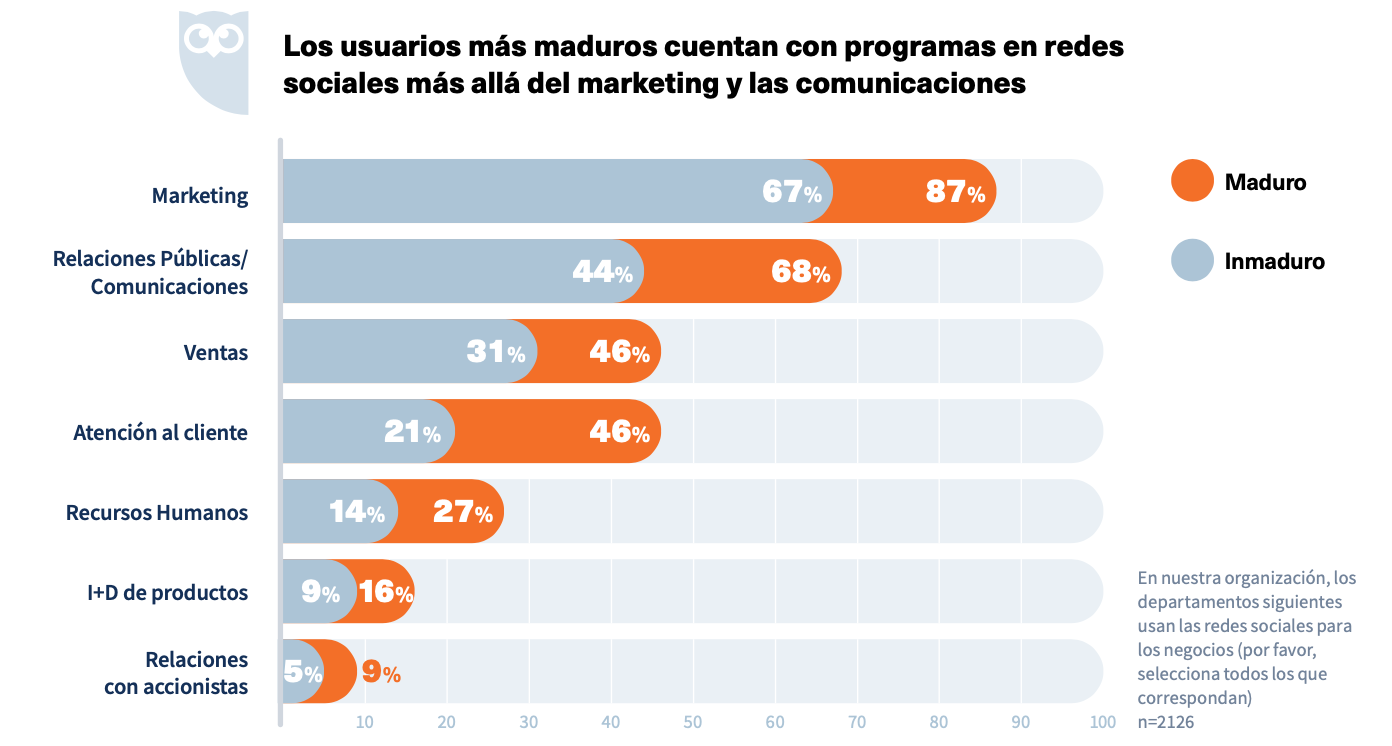
Focusing on employees (employee advocacy), partners and suppliers, investors and shareholders, etc., maintaining a continuous relationship over time and active listening, allows the company not only to keep up to date with its main actors (as happened during the COVID-19 crisis) and to strengthen its relationships but also to improve brand sentiment: 84% of mature organizations saw significant success in improving the fundamental parameters of brand health, such as relevance and positive sentiment.
The study also concludes that social networks boost the company's operational efficiency, allowing for improved sales and reducing the cost of acquiring customers. 78% indicated that social networks allowed them to reach potential customers more efficiently than other media and 58% of digitally mature organizations agree that they have tracked sales that can be partially attributed to social networks.
Tom Keiser, CEO of Hootsuite: “To realize their value, social networks must be connected to the essence and workflow of the entire company, not just to the digital marketing department, and must be completely focused on the customer and their experience. Every employee must be involved in the formation and execution of the company's social media strategy.”
The third and final major conclusion of the study is the capacity of social networks to accelerate digital transformation by driving organizational change. Digital transformation in companies was not taking place at the right speed because it had a lot of technology and little of cultural transformation, but during the COVID-19 pandemic, organizations have understood the value of social networks in facilitating cultural transformation, which is key to digital success. Mature organizations have extended the use of social networks to departments other than marketing and communication, and many executives have begun to have a digital presence, making it easier for organizations to be prepared for a broader digital transformation, as stated by 66% of respondents.
So the three keys to the report They are:
- Social media helps companies build stronger and closer relationships with their investors and shareholders.
- Social media increases brand value and operational efficiency.
- Social networks accelerate the digital transformation of companies.
Finally, based on data from departments that use social networks, it should be noted the low level of penetration of social media programs or strategies to expand or develop relationships with shareholders and investors compared to the high percentage, in the case of public relations or corporate communication. This fact attracts attention because one of the important facets of Investor Relations is not only the message or content that you want to transmit, but also the way in which it is transmitted, and in this regard, social networks can help a lot (audience selection, immediacy, wide dissemination of content, virality, etc.). So there is still a long way to go in terms of social networks and their implementation in Investor Relations programs.
-
Daniel Campoy Silva
Founding partner of Sigma Rocket